Oracle E-Business Suite (EBS) Archival, Retirement & Decommissioning
Retire Oracle E-Business Suite (EBS) Without Losing Historical Reporting Access
EBSArchive is an Oracle E-Business Suite (EBS) archival and decommissioning solution that gives Finance, HR, Supply Chain, and Audit teams secure self-service access to historical Oracle E-Business Suite (EBS) data while reducing legacy infrastructure cost and maintenance.
Keep the historical data your business needs. Retire the infrastructure it no longer needs.
After Oracle E-Business Suite (EBS) Retirement
A simpler way to support the business after Oracle E-Business Suite (EBS) is gone.
For a practical view of Oracle E-Business Suite (EBS) retirement and decommissioning after Fusion Cloud, read The Keepers of Yesterday's ERP .
For CIOs
Reduce legacy infrastructure cost and remove an aging application from the technology portfolio without losing historical records.
For IT Teams
Replace ongoing Oracle E-Business Suite (EBS) maintenance with a customer-owned, low-maintenance archive platform built on managed OCI services.
For Business Users
Search historical invoices, journals, purchase orders, employee records, and attachments without relying on the retired Oracle E-Business Suite (EBS) application.
For Audit and Compliance Teams
Retrieve historical evidence quickly with controlled access, report downloads, attachments, and preserved transaction history.
Business Problems We Solve
Retire and decommission legacy Oracle E-Business Suite (EBS) infrastructure while preserving historical visibility.
Retire / Decommission Legacy Oracle E-Business Suite (EBS) Infrastructure
Shut down aging Oracle E-Business Suite (EBS) environments and reduce the cost of keeping legacy infrastructure running only for historical access.
Keep Historical Data Accessible
Give Finance, HR, Supply Chain, and Audit teams continued access to the historical records they still need.
Respond to Audits Faster
Help audit and compliance teams retrieve historical evidence quickly with controlled access to reports, downloads, and attachments.
Give Users Self-Service Access
Let business users search historical data through a browser-based archive without depending on the retired Oracle E-Business Suite (EBS) application or routine IT assistance.
Enterprise Deployment Experience
Trusted across multiple industries and enterprise environments.
Experience supporting Oracle E-Business Suite (EBS) archival, historical reporting, audit readiness, and cloud modernization initiatives across enterprise environments.
Prebuilt Historical Reports
Explore 160+ reports for historical Oracle E-Business Suite (EBS) data.
Give Finance, Supply Chain, HR, and Audit teams access to historical records for inquiries, reconciliation, and compliance.
Explore Report CatalogProduct Demonstration
See the platform in action.
End-to-end Oracle E-Business Suite (EBS) archival, historical reporting, search, downloads, and audit workflow demonstration.
Archival Process
End-to-end Oracle E-Business Suite (EBS) archival and reporting workflow.
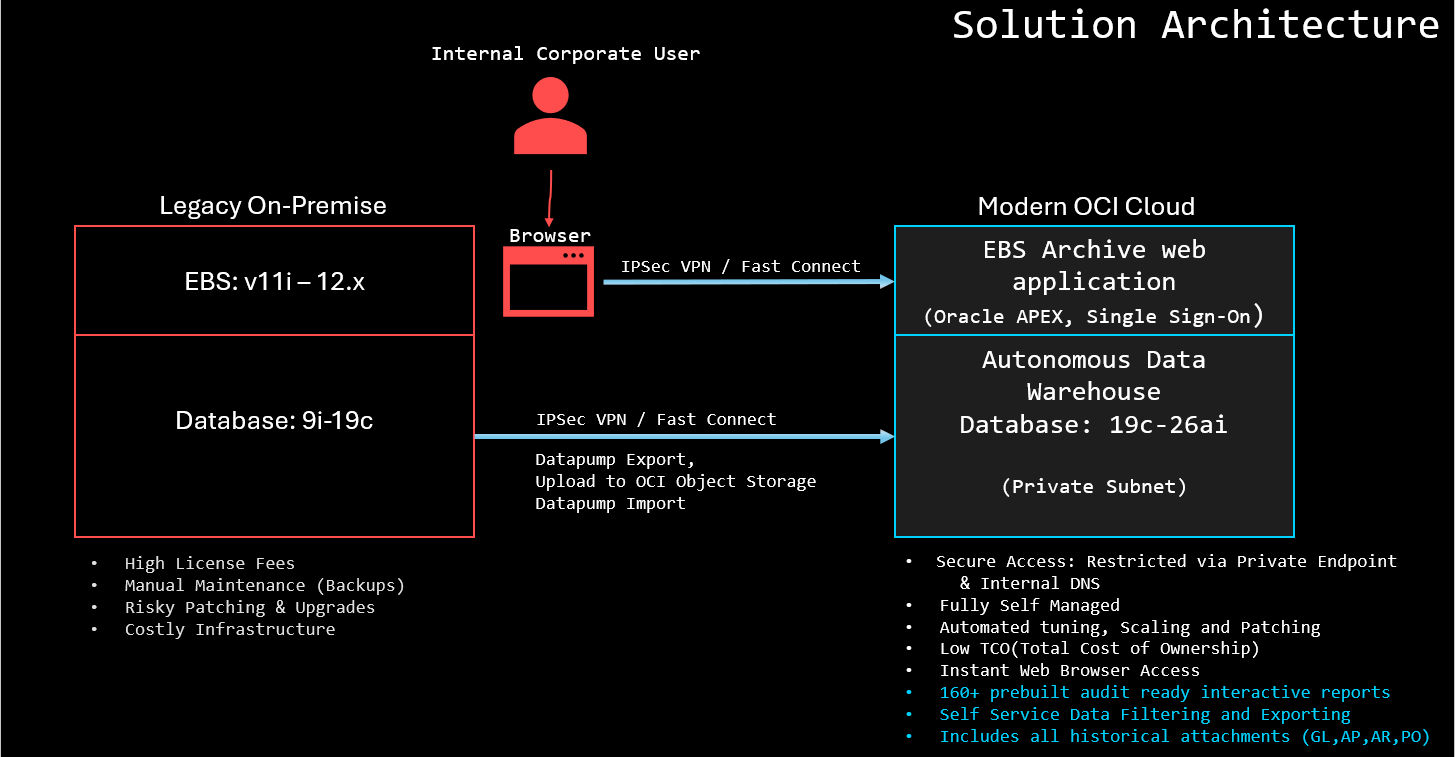
Target Architecture
Secure browser-based access to archived Oracle E-Business Suite (EBS) data.
Supported Versions
Compatible across Oracle E-Business Suite (EBS) and Autonomous Database environments.
Oracle E-Business Suite
Oracle Database
Autonomous Data Warehouse
Frequently Asked Questions
Common questions about Oracle E-Business Suite (EBS) archival and historical reporting.
Can Oracle EBS be fully retired after archival? +
Yes. Customers can retire Oracle E-Business Suite (EBS) after validating that required historical reports, audit requirements, compliance needs, and operational queries are available through the archive platform as part of User Acceptance Testing.
Since the archived EBS data remains accessible through SQL-based reporting and Oracle APEX applications, users can continue accessing historical information without dependency on the original EBS environment.
What Oracle EBS and database versions are supported? +
The solution supports Oracle E-Business Suite 11i, R12.1, and R12.2 environments.
Supported source Oracle Database versions include 11g, 12c, and 19c.
Archived environments can be deployed on Oracle Autonomous Data Warehouse platforms including ADW 19c, 23ai, and 26ai environments.
How long does implementation typically take? +
Typical implementations are completed within approximately 4–5 weeks, depending on customer readiness, environment access, and validation timelines.
- 1 week for discovery and architecture planning
- 1 week for export and import execution
- 1 week for Oracle APEX deployment and validation
- 1–2 weeks for User Acceptance Testing and report refinements
Additional time may be required for environment access approvals, infrastructure coordination, custom report requests, or extended validation activities.
How many users can access the system? +
There is no application-imposed user limit. The solution is deployed within the customer’s own Oracle Cloud environment as a customer-owned accelerator, not a multi-tenant SaaS platform.
User concurrency can scale based on Autonomous Data Warehouse resources, including CPU and storage scaling.
Who owns and manages the environment after implementation? +
The solution is deployed within the customer’s own OCI environment, and customers retain ownership and administrative control of the Oracle APEX application, Autonomous Data Warehouse, storage, and identity management configuration.
Since the platform is primarily designed for historical reporting and archival access rather than high-volume transactional processing, ongoing maintenance requirements are typically minimal.
Does the solution support both greenfield and existing OCI tenancy deployments? +
Yes. The solution can be deployed either in a new OCI environment (greenfield deployment) or within an existing customer OCI tenancy (brownfield deployment).
In both deployment models, we provision dedicated OCI networking components such as Virtual Cloud Networks (VCNs) and related infrastructure following Oracle Cloud best practices for security, isolation, networking, and operational management.
Deployments can also align with customer enterprise standards including identity management, networking, DNS, load balancers, security controls, and operational governance requirements.
Can the application use a friendly corporate URL and HTTPS certificate? +
Yes. The EBS Archive application can be exposed using customer-friendly corporate URLs through OCI Load Balancer configuration and HTTPS/TLS certificates.
Customers can use their own domain names, SSL certificates, and enterprise DNS standards to align the application with existing corporate security and access policies.
Does the solution support Single Sign-On with our Identity Provider? +
Yes. Oracle APEX supports Single Sign-On using OpenID Connect. Customer Identity Providers such as Microsoft Azure AD, PingFederate, Okta, and others can be federated with OCI IAM.
Role-based authorization is managed using enterprise groups to control module-level access.
How is authorization managed for module reports and user access? +
Authorization is typically managed using module-based security groups such as GL, AP, AR, and HR.
Customers can manage these groups through their enterprise Identity Provider integration or maintain local application groups within Oracle APEX.
Does the solution support Multi-Org Access Control and organization-level security? +
Yes. The solution supports data-driven Multi-Org Access Control using Business Group, Operating Unit, Ledger, and Legal Entity dimensions.
Underlying data-level security is enforced using Oracle Virtual Private Database policies.
Can users export or download report data? +
Yes. Oracle APEX Interactive Reports allow users to search, filter, personalize views, save filters, and download data in CSV and Excel formats.
Are Flexfields and Flexfield Segments supported? +
Yes. Prebuilt reports include Descriptive Flexfields and Key Flexfield segments wherever applicable across supported Oracle EBS modules.
Can custom reports or BI Publisher reports be added? +
Yes. Existing custom reports and BI Publisher SQL queries can often be adapted or migrated with minimal changes using native Oracle SQL reporting patterns.
Can the solution be extended with additional reports? +
Yes. Since the archive preserves Oracle EBS tables, views, and reporting structures, Oracle EBS developers can easily build additional SQL-based Interactive Reports.
Are attachments and supporting documents archived and accessible? +
Yes. Oracle EBS attachments such as invoices, purchase orders, receipts, requisitions, and journals can be archived and accessed through the EBS Archive application.
The solution also supports external repositories such as MarkView, SharePoint, and centralized document management platforms.
Can custom schemas and custom EBS extensions be archived? +
Yes. Customer-specific schemas and custom EBS extensions can be archived alongside standard Oracle EBS schemas using selective schema imports.
How do we verify that all required EBS data has been archived completely? +
Oracle Data Pump export and import logs are validated to confirm successful migration and matching table-level row counts.
What data validation is performed after migration? +
Validation includes table counts, object validation for packages, procedures, views, functions, and User Acceptance Testing for reporting and search functionality.
Some Oracle EBS objects may remain invalid because Oracle-maintained SYS schema objects are not imported, as they are not required for historical reporting workloads.
What happens if some Oracle EBS reports or SQL queries are slow after archival? +
Reports are tuned using optimization techniques such as partitioning, indexing, and materialized reporting tables to support fast historical access.
For very large downloads or long-running extracts exceeding application timeout thresholds, Oracle DBMS_CLOUD.EXPORT_DATA can export query results from the archived database to OCI Object Storage. Authorized technical users can also execute SQL directly using tools such as SQL Developer, SQLcl, or SQL*Plus when appropriate.
Can the solution support multiple Oracle EBS instances? +
Yes. Each Oracle EBS instance can have a dedicated ADW and Oracle APEX deployment, with optional centralized portal access across environments.
Multi-instance environments can also share centralized navigation and reporting access patterns while maintaining isolation between archived environments.
Can the archived environment be extended for analytics, AI, or future modernization initiatives? +
Yes. Oracle Autonomous Data Warehouse supports SQL Analytics, Machine Learning, and Select AI capabilities directly on archived Oracle E-Business Suite (EBS) data.
Since the historical data remains accessible through standard Oracle SQL, customers can extend the environment for dashboards, analytics, reporting modernization, AI-assisted querying, and future cloud data initiatives.
How are upgrades and maintenance handled for the platform? +
Oracle Autonomous Data Warehouse is a fully managed Oracle Cloud service handling patching, backups, upgrades, and infrastructure maintenance automatically.
Since the platform is optimized primarily for historical reporting workloads rather than transactional processing, ongoing maintenance requirements are generally minimal.
What customer teams are typically involved in the project? +
Typical project participation includes Project Management, Infrastructure and Cloud teams, Finance users, HR/Payroll business users, security teams, and Oracle EBS functional or technical resources.
User Acceptance Testing is usually performed by business users responsible for audit, compliance, operational reporting, and historical data validation.
Plan Your EBS Retirement
Ready to retire Oracle EBS without losing historical visibility?
Discuss your EBS environment, historical reporting needs, retention requirements, and retirement timeline. Share a few details to arrange a 30-minute consultation.
Use email for direct inquiries, or the guided chat to share your environment and requirements.